
Name-Based Case Searches
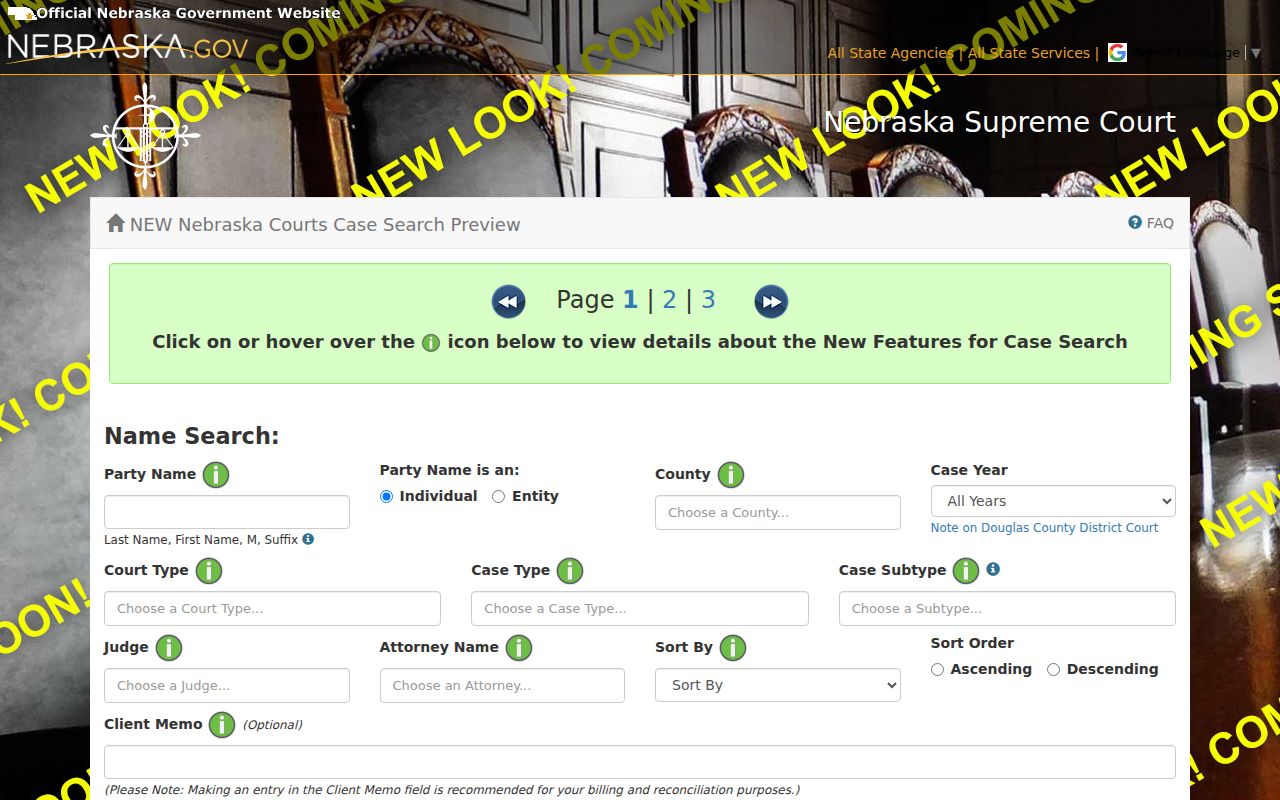
For a Keith County court docket search by person or business, the remote starting point is the public Nebraska JUSTICE name search. Accept the terms first. Remember that the tool searches for parties, not witnesses, so a witness name will not pull up a Keith County case. Enter the name as fully as you can. The official demonstration follows the format "Last Name, First Name, M, Suffix" and warns that one mismatched middle initial can hide a matching case from the results.
Choose individual or entity when the form asks. Then start broad. A Keith County case search can be narrowed later by county, year, court type, case type or subtype, judge, attorney, and sort order. That is safer than stacking filters at the outset and accidentally excluding a Keith County court docket filed under a slightly different name or detail.
- Open JUSTICE, accept the access terms, and choose a party-name search.
- Enter the party name in the displayed last-name-first format and choose individual or entity.
- Review the broad Keith County result set before adding the county, year, court, case type, subtype, judge, or attorney filters.
- Open the likely case detail and compare its caption, case number, status, and Register of Actions with the question at hand.
The official JUSTICE field demonstration walks through every control the search offers. It earns its keep when a Keith County name search returns several parties who look alike.
| Portal field | Type | Required | Keith County use |
|---|---|---|---|
| Party | Text | Yes | Search a party, not a witness; use the displayed name format. |
| County | Selection | No | Choose Keith County after a broad search when local results are needed. |
| Year | Selection | No | Use an approximate filing year to trim a large result set. |
| Court | Selection | No | Separate County Court from District Court results. |
| Case type / subtype | Selection | No | Use only when the likely Keith County case category is known. |
| Judge / attorney / sort | Selection | No | Refine an ambiguous result list rather than guess at the first search. |
Keith County Docket Search Field Rules
The public name search is a paid, one-time access path rather than a standing account. Current JUSTICE terms list a $17 charge. It applies even when the search returns no result. Access lasts three calendar days. It can return up to 30 public cases, so write down the search date and the case number before the window closes. Expect a lag, too. Information can take up to 24 hours after entry to appear, so a new Keith County filing may not show immediately.
For repeated professional use, the state offers a subscriber service with an annual account listed at $100 and trial-court details generally listed at $2. Its account and detail rules differ from the one-time path. Neither route displaces the Keith County clerk. The clerk controls certified copies, file questions, and anything touching restricted material.
Note: If a Keith County search runs less than a day after a filing, check again later. Confirm with the clerk if the docket entry still has not appeared.
Case Number Searches
A case number is usually the cleaner route into a Keith County court docket. Copy it exactly as JUSTICE displays it, letters and spaces included. Nebraska case numbers encode the court indicator, county number, case type, year, and sequence. Do not build a Keith County number from a pattern. Do not hard-code the county code in a request. Take the full identifier from an official result, a notice, or a clerk record.
The court indicator is commonly C for County Court. D stands for District Court. Type markers you will see include CI for civil, CR for criminal, JV for juvenile, PR for probate, SC for small claims, and TR for traffic. Two Keith County cases with near-identical captions can still sit in different courts. Each has its own Register of Actions.
The official result demonstration shows how a case number appears beside the caption, judge, attorney, and detail link.
Keith County Case Code Clues
In Keith County searches, treat the court and the case type as two separate clues. County Court handles traffic, misdemeanors, small claims, probate, and other limited-jurisdiction matters. Keith County District Court keeps its own docket. That docket covers felony cases after bindover, broader civil litigation, domestic-relations matters, and appeals. Sharing a courthouse address does not make the two record systems interchangeable.
If all you hold is a reference to a hearing, get the case number from JUSTICE or the Multi-Court Case Calendar first. Then confirm the Keith County court level. The calendar is built for settings. The case search opens the case summary and Register of Actions. The Keith County Court office sits in Room 105. The Keith District Court sits in Room 202. Both are at 511 North Spruce Street in Ogallala.
Note: A code only identifies a record category; the current case detail and clerk confirmation supply the authoritative context.
Case Search Results Explained
Before opening a case, a Keith County result row helps separate similar names. The row can show the party, case number, caption, judge, attorney, and a detail link. Inside the case detail you get dates, status, costs, and payments. Register of Actions entries appear too. Any available image links show up as well. Treat a result as a way to locate a public court record, not as a stand-in for reading the filed order or judgment. That filed paper controls the case.
| Case number | The exact identifier for the Keith County court and case category. |
|---|---|
| Caption and parties | The formal title and the parties tied to the public case summary. |
| Judge and attorney | Result fields that help distinguish same-name cases, when available. |
| Type, subtype, and dates | The case category, filing information, and public status markers. |
| Register of Actions | A chronological record of filed and court actions, rather than a recreation of every document. |
| Images | Links or image IDs for available filed material, not a promise that every Keith County document is scanned. |
The official results screen lays out the row fields a searcher sees before opening any Keith County case detail.
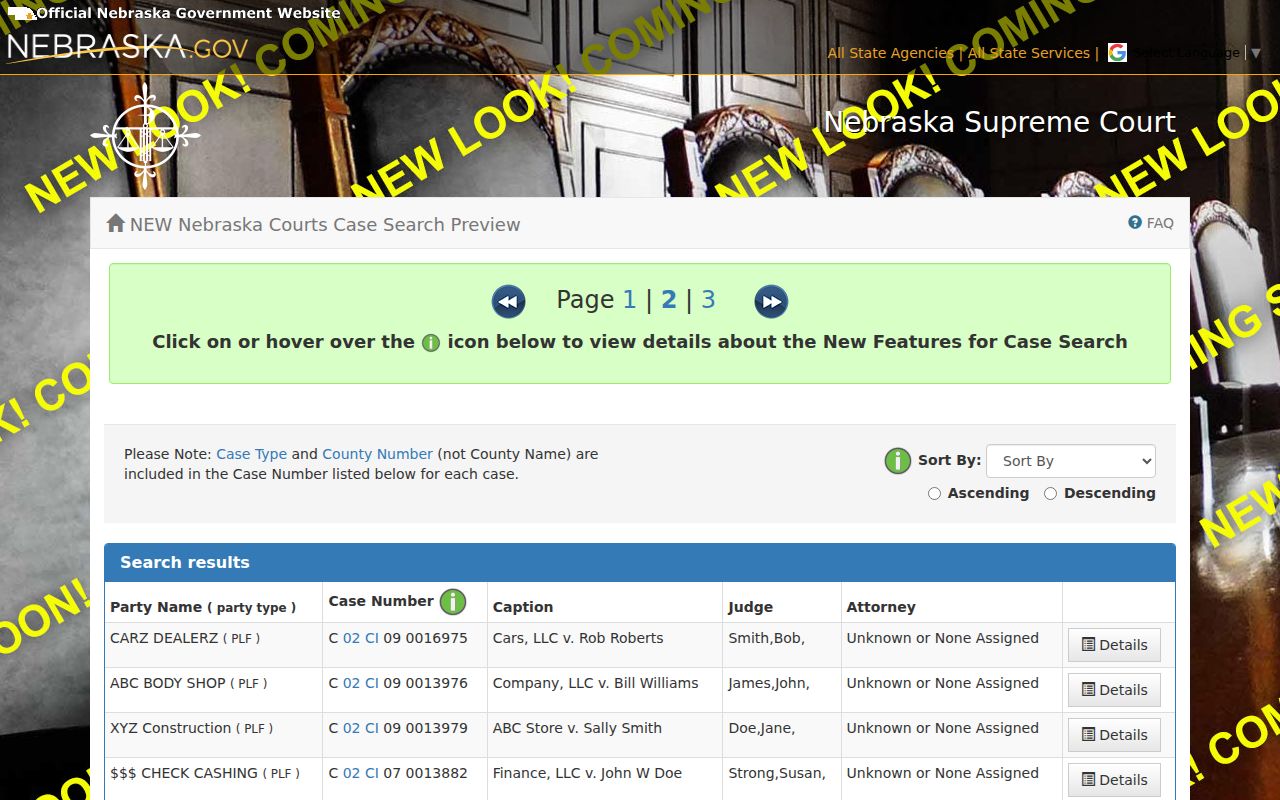
Those fields let a Keith County searcher compare the returned case against the available court record. That check beats trusting a name match alone.
Keith County Register of Actions Detail
The Register of Actions is the running log inside a Keith County court docket. Filings, notices, hearings, orders, and judgments appear in order. Think of it as an index of events. It does not reproduce every pleading, exhibit, or order in full. Most entries just name the document. When a specific document matters, note its name. Ask the Keith County clerk for the public version or a certified copy that is available.
The state's case-detail demonstration shows how a case summary, financial fields, payment information, and the Register of Actions fit together. The official JUSTICE search demonstration also shows the search entry point that leads into a public detail view. A clickable image link is handy. That does not put the whole Keith County file online.
The takeaway is simple: read the entry date, the event description, and any linked document as one unit when following a Keith County case. Guesswork drops away when those three pieces agree.
Keith County Case Search Images
An image ID or document link in a Keith County case detail means one thing: a filed item is available to open. It does not mean everything was scanned. Not every pleading, exhibit, or order gets imaged. Before trusting a link, compare the item with the Register of Actions entry, its date, and the case caption.
When no public image appears, do not assume the docket entry supplies the full text. Ask instead. A copy request has required parts. Ask the Keith County clerk for the named public document, and identify the court, the case number, the document, and whether an ordinary or certified copy is needed.
Two Ways to Search: County and State
JUSTICE is the statewide layer for searching a Keith County name or case number. The Multi-Court Case Calendar is the statewide layer for a current or future setting. Neither replaces the local clerk. For a file, a certification, historic material, or confirmation, the clerk's office is the route. Keith County offers no separate public local docket portal. Statewide and local tools work together, not in competition.
| Statewide portal | Keith County clerk route |
|---|---|
| JUSTICE searches public party and case information across participating trial courts. | County Court and District Court staff locate the court-held file and explain copy procedures. |
| The Multi-Court Calendar checks a scheduled date by court, county, date, or last name. | A clerk can confirm the Keith County assignment when a calendar result is blank or unclear. |
| Public results can include case summary, costs, payments, ROA entries, and available images. | Written requests are appropriate for a particular public document, older material, certification, or transcript process. |
At the courthouse, ask the right Keith County clerk where a public-access terminal or file-copy process is available. Terminals are a real possibility. Nebraska's public-access rules and the state case-information service both contemplate remote access and courthouse terminals. Keith County posts no terminal count or schedule.
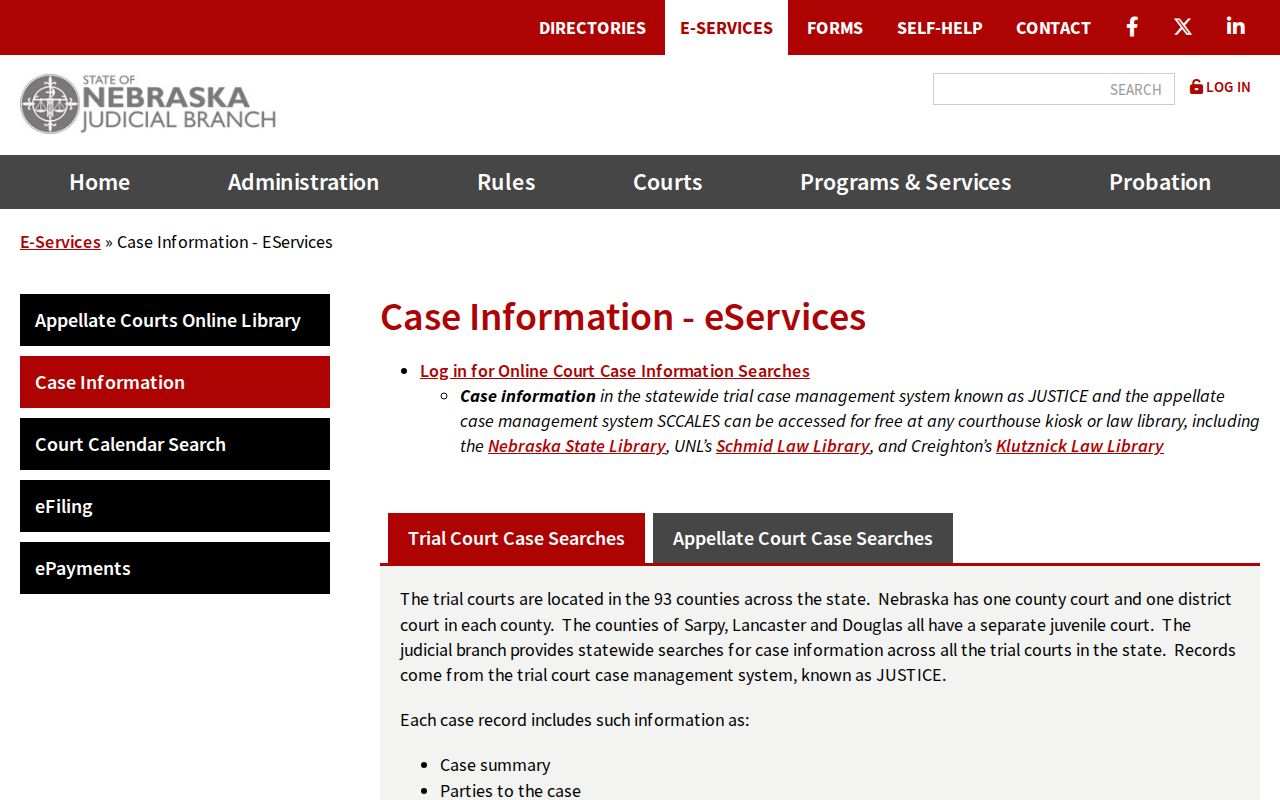
Keith County docket search fits the state's public-access system.
Keith County Docket Search Dates
Start with a Keith County case search to identify the case and its latest public activity. Use the Multi-Court Case Calendar for a scheduled appearance. Pick the correct court and county first. Then search by a current or future date, or by a last name of at least two characters.
A blank calendar proves nothing. The calendar itself warns that timely entry of settings may fail. Save the returned case number. When the date affects a planned appearance, call the appropriate clerk for the current assignment.
Keith County Docket Search Costs
The public JUSTICE name-search charge is separate from any clerk copy charge. You pay it even when no case comes back. A subscriber account is different. It follows the subscription terms for account access and case details, not the public rules. Keep your search receipt. Hold it with the access date and the exact Keith County case number in case a clerk request follows.
The JUSTICE terms allow personal viewing and printing only. They also place conditions on redistribution of anything you print. So a search locates a record. For a public paper or electronic copy, direct the request to the court that maintains the record and specify the case number, document, date range, and whether an ordinary or certified copy is needed.
The official JUSTICE terms and conditions spell out the access conditions for public searches.
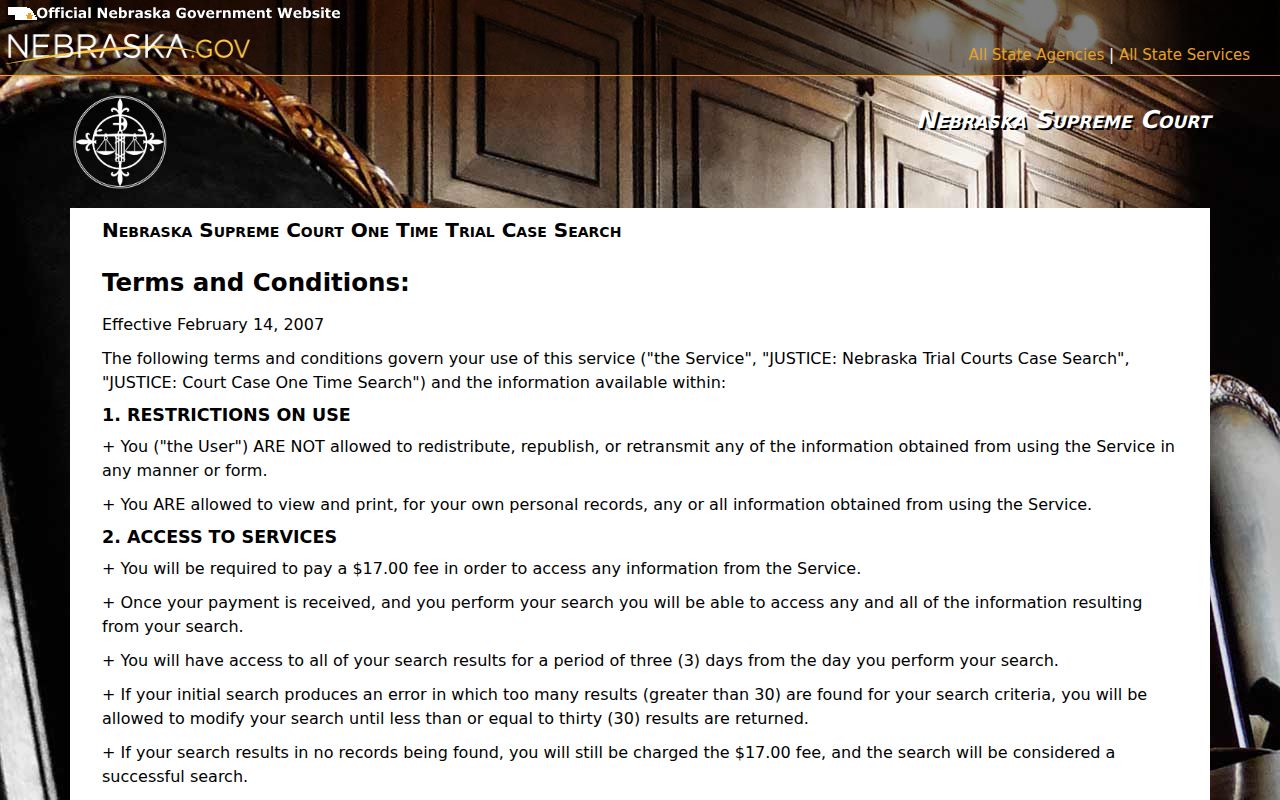
Reading the terms first saves money and effort. It helps a Keith County searcher choose a name search, a subscriber service, or a clerk request for the real need. The subscriber information page describes the separate account option.
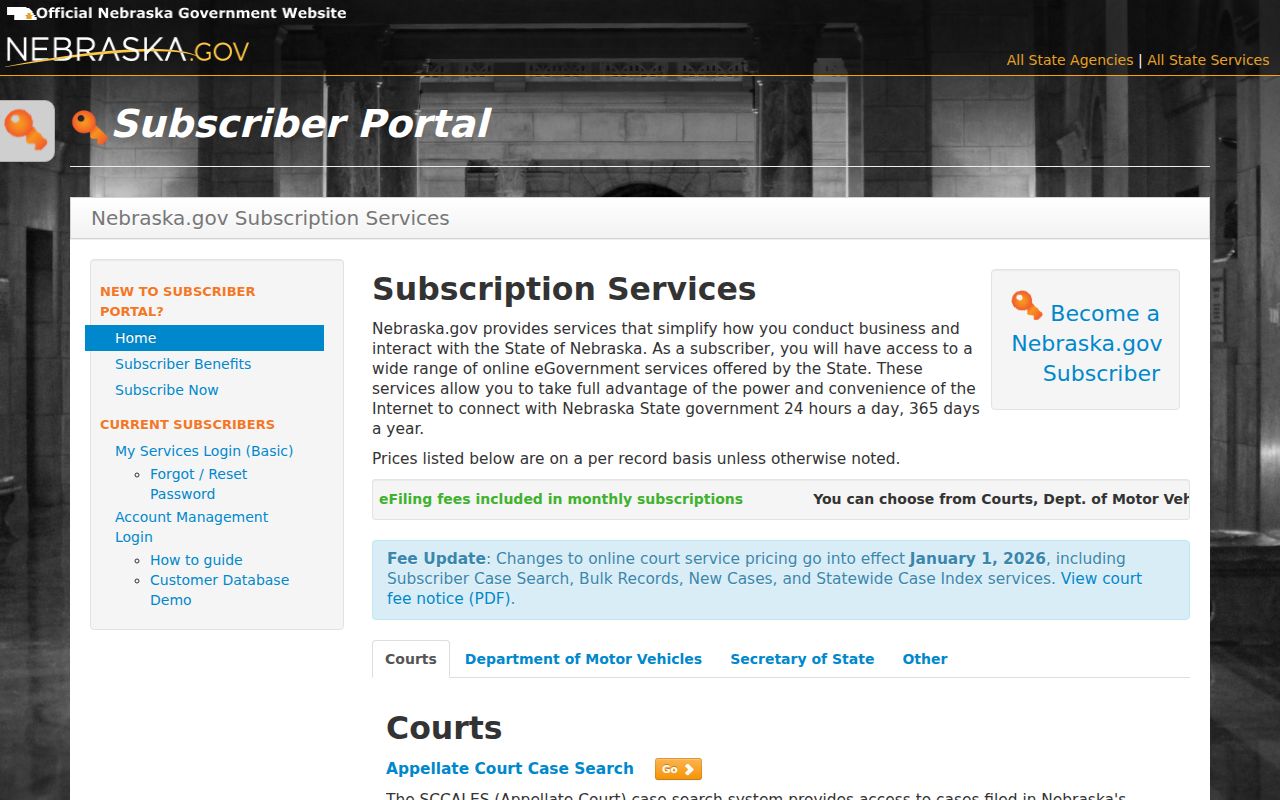
Subscription access can open a different detail path. It still cannot replace the Keith County clerk's copy or certification role.
Keith County Case Search No-Result Checks
A blank result means you should check the search itself, not conclude anything about a Keith County court record. Start with spelling. Then review name order, the middle initial, entity choice, the court filter, and the filing year. Try the broader form of the party name. If a hearing date is the issue, search the calendar by date or last name, then call the court, because the calendar warns that timely entry can fail.
Written requests need specifics. Name the court, the party, the approximate year, the case type, and any case-number fragment. The two courts sit in different rooms. For County Court matters, contact the Keith County Court in Room 105 at 308-284-3693. For a District Court matter, contact the Clerk of Keith County District Court in Room 202 at 308-284-3849 or tdevoe@keithcountyne.gov.
Note: Court staff can confirm records access and public availability. They cannot give legal advice or disclose sealed contents.
Which Cases Stay Restricted
What can the public see in a Keith County court docket? Party indexes, case summaries, and Register of Actions entries are generally open. Calendars, judgments, orders, and decrees are too. Another rule or court order can still limit access. So a docket search may return nothing or only part of a file. That happens when the case is restricted. It also happens when a document has no public image, or when a privacy rule requires a version with protected details stripped out.
Juvenile files call for special care. Nebraska treats a sealed juvenile record as though the proceeding never happened for public-disclosure purposes. Authorized access can still be granted. The honest answer is that the matter is not publicly available through this search. It is wrong to claim no record exists. Ask the Keith County clerk only whether a public case summary is available. If you seek authorized access, follow the court's process.
Restricted Keith County Case Searches
Sealing, redaction, and a missing online image are three different problems. Civil privacy rules shield birth dates, gender, Social Security numbers, and financial-account numbers. That protection applies to the public-facing record. A restricted Keith County case might show an index entry. It might show only a limited public summary. Or it might show nothing at all, depending on the controlling rule or order. The clerk cannot hand over material that public access rules withhold.
If a public image is missing, ask for the exact document by name. Don't request a full docket printout. For a copy, certification, recording, or a historical file, the Keith County court case records route is better. That route is the next step. Say whether a plain copy will do. Don't try to reach protected material through a broad name search.
Before contacting the clerk, pin down the public case number. The official JUSTICE public search works well for that.
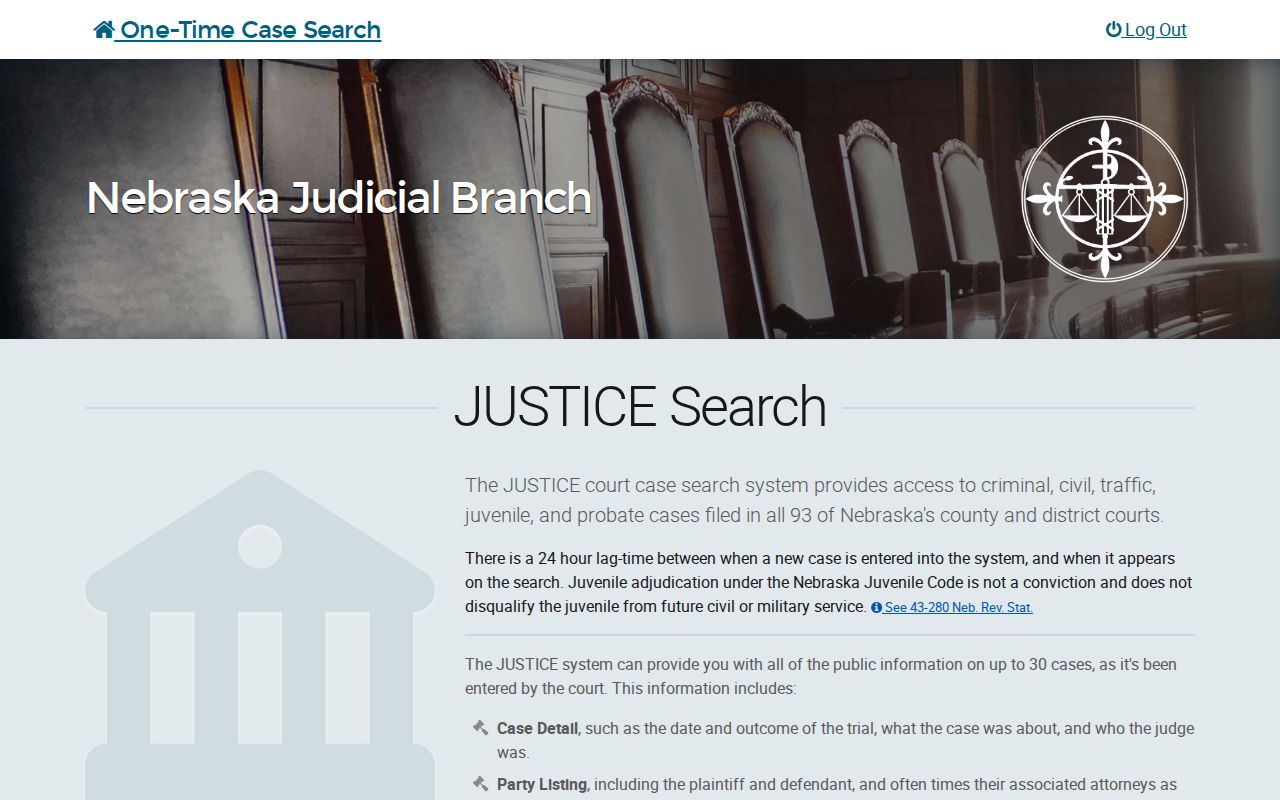
A Keith County docket search can locate whatever case summary is public. Getting at the record itself still turns on court rules and the clerk's file process.